10 interesting vessels to sail through Tower Bridge
Tower Bridge opens its bascules around 500 times a year. The types of boats, barges and ships that visit continue to change, from cargo vessels and paddle steamers to pleasure cruises and royal yachts.
Here are 10 iconic boats and ships that have passed through Tower Bridge since the opening at 1894.

The first Bridge Lift
Everyone wants to be the ‘first’ to do something: first man on the Moon (1969), first selfie (1893), first video on YouTube (2005), but what was the first vessel to pass through Tower Bridge?
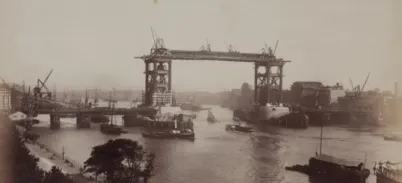
Tower Bridge was officially opened on 30 June 1894 by HRH the Prince of Wales (later King Edward VII from 1901-10). Huge crowds lined the Thames in giddy anticipation. As the clock turned midday, the ceremonial trumpets sounded, the Bridge was blessed and, after a two minute delay ‘during which the crowd held their breaths’, the Bascules lifted for the first time. In celebration, the guns of the Tower of London fired a Royal Salute and the ships began their approach…
First through the Bridge was the Harbour Master’s vessel Daisy. It may have been the first, but it was quickly followed by a procession of honourary vessels: the Conservator Steamer; then the Trinity House Yacht Irene; the gunboat HMS Landrail; the Bismark; and the Clacton Belle. These last three can be seen in William Lionel Wyllie’s painting ‘Opening of Tower Bridge’, pictured adjacent, which is on show at the Guildhall Art Gallery.

The Royal Yacht Britannia
In the Spring of 1954, thousands of Brits flocked to the banks of the River Thames to see the Royal Yacht Britannia pass under Tower Bridge, bringing Her Majesty the Queen and her family home from a Commonwealth tour that lasted six months. It was the first to be undertaken by the Royal Yacht Britannia, which the Queen had launched herself in 1953.
During its career as Royal Yacht, Britannia conveyed the Queen, members of the Royal Family and various dignitaries on 696 foreign visits and 272 visits in British waters. Charles and Diana, the Prince and Princess of Wales, took their honeymoon cruise on Britannia in 1981. The Royal Yacht Britannia also made a visit to the Thames at Tower Bridge to honour the Queen Mother's 90th birthday in August 1990.
On 20 October 1997 the royal yacht made its final journey passing through Tower Bridge. It was decommissioned in 1997 and is now berthed in Edinburgh, where it opened in 1998 as a star tourist attraction.

Cruise ships in London
London’s own sea cruise
The British seaside getaway is an iconic part of the country’s history. Ice cream, arcades, beaches and piers; what’s not to love.
In 1932 the Royal Eagle was one of the biggest, fastest, luxury paddle steamers, ferrying passengers between London and several seaside destinations including Southend-on-Sea, Ramsgate and Margate. Between 1932 and 1938, it’s estimated it carried more than three million passengers – that’s half a million passengers every summer.
The Royal Eagle would take day trippers through Tower Bridge and along the Thames towards Ramsgate and Clacton. Guests were treated to fine dining and relaxing lounges. Passengers snooze on deck, and, as was the fashion of the day, almost everyone wore a hat.
You can still take this journey on either pleasure Steamers Waverley and Balmoral, which depart from Tower Pier. You can sail back in time aboard these wonderful historic passenger ships to the Kent and Essex coasts and to the historic Thames Forts.
On 2 October 2026, Paddle Steamer Waverley celebrated 80 years since she was first launched into the River Kelvin, Glasgow. This anniversary is particularly significant given how few steam ships have ever had a career that spanned eight decades. The slider below shows her launch in 1946 compared to her sailing through Tower Bridge in her 80th year - images from Waverley Excursions.


A modern spectacle
It’s not everyday you expect to see a cruise ship entering central London, but since 2013, the city has attracted no less than 30 cruise ships a year: the Hamburg, Le Boreal, Silver Cloud and Silver Wind and many others have passed under Tower Bridge.
These mammoth vessels are much larger than the ships that originally passed through in 1894, but ships like the enormous Silver Cloud, at 157m long, still manage to squeeze through carrying up to 300 passengers and a crew of 222.
You can get a spectacular view of the ship passing under Tower Bridge through the Glass Floor. They are so tall, sometimes it seems you can almost touch them.

Naval visitors
HMS Belfast
Light cruiser HMS Belfast passed under Tower Bridge to take its mooring in the Pool of London on 14 October 1971.
The following day, 15 October 1971, HMS Belfast was towed to its resting place and attached to two dolphins, which guide the ship during the rise and fall of the tide.
Built by Messrs Harland & Wolff in 1936 and launched on 17 March 1938 by Anne Chamberlain, the wife of Prime Minister Neville Chamberlain, HMS Belfast was opened to the public six days later, on Trafalgar Day, 21 October 1971. It became part of the Imperial War Museums in 1978.

JS Kashima
Japanese ship Kashima (TV-3508) passed under Tower Bridge on 5 September, berthing next to HMS Belfast and leaving on 9 September as part of an Overseas Training Cruise in 2024. Ambassador Hayashi Hajime welcomed JS Kashima as it passed under Tower Bridge.
Previously, it has also visited the morning of 22 June 2022. The training vessel made its way upstream the Thames and berthed near the Tower of London, where it stayed until 25 June. It then sailed downstream, crossing our bascules once more on its way back to the sea.
The Kashima came to London, while JS Shimakaze was called at Portsmouth, to promote ‘friendship and goodwill’ between the Japan Maritime Self-Defence Force (JMSDF) and the Royal Navy. On 28 June 2022, the ships conducted a bilateral exercise with HMS Severn in the English Channel.
The visit of the Kashima and the Shimakaze to England echoed a stopover to Japan by Royal Navy’s Carrier Strike Group in 2021, and it marked the 120th anniversary of the Japan-UK alliance.
The Kashima visited London and passed under Tower Bridge also on 31 July 2016.

When things don't go according to plan
The bridge lift that wasn’t booked
On the morning of 15 May 2004, the STS Lord Nelson set off along the Thames towards Tower Bridge and the Pool of London, expecting the Bridge to lift. The impressive three-mast vessel, along with the SV Tenacious, were the only wheelchair accessible tall ships in the world, built so that both disabled and non-disabled people could sail as crew.
As the vessel approached Tower Bridge, they radioed ahead, as is normal procedure, but received no response. As the Nelson got closer and closer to the the Bridge, further attempts to contact were met with silence and the Bridge didn’t look like it was ready to open. Finally, through Woolwich Radio, the crew had made contact with the staff at Tower Bridge and it was ascertained that no Bridge Lift had been booked! The experienced crew set to action to turn the boat around in time… but it was too late.
Due to the current, and the proximity to other vessels the Lord Nelson struck the south pier of Tower Bridge just after 10:00. Fortunately, no one was injured and there was very little damage to the ship.
A later enquiry vindicated Tower Bridge authorities, after it established that no notice for a Bridge Lift had been sent or received.
The Lord Nelson was decommissioned in 2019 but the SV Tenacious still sails today.
Third time's the charm
If you think hitting the Bridge once is embarrassing, spare a thought for the Spanish Cargo Ship Urquiola. On 30 January 1967 the Urquiola hit Tower Bridge for the third time in ten years (1957, 64 & 67). A police spokesman announced: ‘they are starting to make habit of it’.
The damage report, date 30/1/1967 states:
"Tower Bridge was closed to traffic for an hour and a half today (Monday) after being hit and damaged by a Spanish cargo vessel. The 7,000 ton Monte Urquiola swung broadside into the bridge as it was being towed to the Pool of London. It smashed into the north east buttress sending blocks of masonry tumbling into the river".
The Monte Urquiola (1949-74) was one of four ships operating for the Aznar Line until Autumn 1974, and was a frequent guest in the Pool in London. The Aznar Line operated a large share of the Canary Islands fruit and vegetable market to Britain, sailing to both London and Liverpool.
The Monte Urquiola was renamed In 1974 and decommissioned in 1977.

London 2012 Olympic Opening Ceremony
In the Summer of 2012, Olympic fever struck London. For just over two weeks, athletes came from all over the world to compete in the world’s greatest sporting event. London 2012’s opening ceremony, arguably the best yet, showcased the British spirit to the world and some of the city’s most iconic landmarks.
An estimated 900 million people watched David Beckham driving the speedboat Max Power, carrying Torchbearer Jade Bailey and the flame on its penultimate stretch along the Thames. As the speed boat powered towards the Bridge, the Bascules raised and fireworks flew from the high-level Walkways. A curtain of sparks fell from the Bascules as the boat continued on its way to the Olympic Stadium - one of the defining images of the London 2012 Games.
The speedboat was a Bladerunner BR RIB 35 called 'Max Power' and fitted with two Mercury Verado V6 engines providing a maximum speed of 65 knots (75mph). It is reported to have been sold for £250,000 after the opening ceremony.

Historical replica vessels
The El Galeon Andalucia of Spain, a 17th Century Spanish Galleon Replica, passed through Tower Bridge into the Pool of London and back on 23 September 2024. It docked in St Katherine's Dock until 13 October.
El Galeon was built during 2009 to 2010 by the Nao Victoria Foundation and is an imposing ship, measuring 55 meters in length, with six decks, constructed from iroko and pine wood, and nearly 1000 m² of sail surface spread across its seven sails. Between the 16th to 18th centuries, Galleons were the boats that took the lead role in the trade and cultural routes of the Indies fleets.
The Götheborg of Sweden, one of the world’s largest ocean-going wooden sailing vessels, passed through Tower Bridge’s bascules up and down the river on 8 August 2022.
The ship moored in Canary Wharf until 12 August as part of a two-year-long expedition from Stockholm to Shanghai. The Götheborg is a replica of an 18th-century ship that sank off the coast of Sweden in September 1745 and that it was owned by the Swedish East India Company.
The Götheborg first visited in London in 2007, when it fired its cannon in salute, with HMS Belfast’s guns firing in return.

Poetry of a Bridge Lift
"Close your eyes
and picture a bridge.
Isn’t this the one you see?..."
Listen to a poem by City Bridge Foundation’s poet-in-residence, Cecilia Knapp.
Bridge Lift is a lyrical and visual tribute to Tower Bridge and explores themes of movement, identity, connection, and change.


Book tickets now
Discover more about the fascinating history of Tower Bridge, its people and their stories.