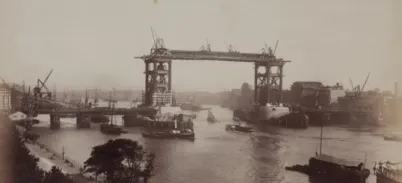
Exploring an archive of Tower Bridge history
Discover how rare documents of Tower Bridge's past are being preserved for future generations at The London Archives.

Unboxing years of history
Much of Tower Bridge's history is recorded on paper.
Thousands of historic working documents tell the story of London's defining landmark through time, from workers' pay books to visitor postcards and detailed architectural drawings.
A fascinating project at The London Archives is helping to preserve this rich history for future generations, commissioned by City Bridge Foundation, who owns and manages Tower Bridge.
We visited The London Archives to explore some of the rare documents uncovered as part of this project, with Tower Bridge Archivist, Dan. We also discussed the delicate process of repairing typical damage to these aging documents with Conservator, Maddie.
Watch the video to view these exceptional documents, and unbox Tower Bridge's history.

The rules behind the Bridge
Did you know Tower Bridge once opened on demand, day or night, whenever a ship needed to pass?
The original Act of Parliament set out bylaws for how Tower Bridge lifted. And from the very start, the Bridge was designed to prioritise river traffic over road and pedestrian traffic.
It wasn’t until the 1970s that the rules changed, and ships were required to give 24 hours' notice before a Bridge Lift.
Find out more about the historic bylaws, curious rules and the stories that reveal how Tower Bridge has kept London moving since 1894.

Tower Bridge plans
The London Archives is full of historic Tower Bridge plans that reveal the extraordinary engineering behind the iconic structure.
From detailed Victorian blueprints showing every rivet and component of the Bridge's foundations to 1980s refurbishment plans for the High-Level Walkways, the drawings highlight the technical precision that has kept Tower Bridge operating for more than a century.

Working drawings
Original working drawings, like this detailed drawing of the Tower staircases, show how engineers and builders made handwritten amendments and practical adjustments during construction.
The pencilled annotations documenting changes made on-site and instructions for contractors.
Beyond their historical significance, these plans remain an important resource today, helping engineers understand and maintain the Bridge.

Explore more
Interested in historical documents and photography of Tower Bridge? Explore photographs unseen for over a century that documents the opening weeks of Tower Bridge in 1894.