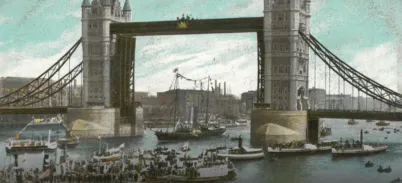
Reveal Tower Bridge's hidden stories
There is so much to explore inside Tower Bridge, from the unique views of the city to the history of London's defining landmark.
London's Defining Landmark

Tower Bridge is a unique landmark. Built as a working bridge to allow ships to pass while keeping road and pedestrian traffic running, it became a visitor attraction, a venue for hire and a filming location around 40 years ago. You might recognise it from a visit to London, or from a Hollywood blockbuster!
From heart-warming details about our workforce to operational secrets, curious facts to daring feats, we invite you to peel back the layers and reveal the hidden stories of an ever-changing Victorian icon!
Bridge Lifts

Tower Bridge's bascules were designed to open to allow vessels access to the Pool of London, the busiest port in the world during the Victorian era. In 1894 - the Bridge's first year of operation - there were 6,194 Bridge Lifts. An average of 17 per day!
The bascules were operated by hydraulics, using steam to power the pumping engines. However, since 1976 Bridge Lifts have been driven by oil and electricity.
The Bridge still opens for ships to pass, now around 500 times a year for vessels such as JS Kashima and Götheborg of Sweden. Visitors can watch the mighty bascules in action through the Glass Floors, a truly remarkable experience.
Venue hire

Our Glass Floors and Engine Rooms make unique venues for birthday parties, networking events, product launches, and business dinners.
Celebrate your special occasion in an unforgettable, iconic setting!
Did you know
You can get married inside Tower Bridge? Celebrate your wedding party in style on the High-Level Walkways!
Glass Floors

Tower Bridge's Glass Floors were installed between November and December 2014. They measure 11.5m long and 1.8m wide, and comprise six different panels. Each of these panels weigh a whopping 530kg and are 70mm thick!
The Glass Floors are in fact so strong that they could hold the weight of six elephants or 12 London taxi cabs! It took six weeks and a team of 20 to put each one of them in place.
The top layer of the Glass Floors is dubbed 'the sacrificial layer'. This is regularly replaced to ensure visitors get the best views, 42m above the Thames and 33.5m above road level.
As seen on the big screen

Tower Bridge represents London in such a way that it is no wonder it regularly features on the big - and the small - screen.
From silent films like 'Gorgo' (1961) to Hollywood blockbusters such as 2019's 'Spider Man: Far from Home', the Bridge has graced the silver screen multiple time. The landmark also appeared in TV classics such as 'Friends' and 'Dr Who', music videos like One Direction's 'Midnight Memories' and a number of games, including 'Watch Dogs Legion' (2020).
Looking at the Bridge, it is easy to understand why directors love it so much, and why it became such an icon of London.
The Engine Rooms

The Engine Rooms were once the beating heart of Tower Bridge. The steam engines powered the opening of the mighty bascules for over 80 years.
Around 30 people worked inside the Engine Rooms every day of the year until 1976, when the Bridge switched from steam power to electricity. The stokers used to shovel more than 20 tonnes of coal per week!
These steam engines, alongside the original coal-fired boilers, drivetrains, and accumulators, are now on display in the Engine Rooms for visitors to enjoy.
The workers

It took the tireless labour of 432 construction workers per day to build Tower Bridge. The build took eight years (1886 to 1894).
Roles and skill were multiple and varies, from bricklayers to divers, riveters to engineers. Many of these workers, like crane driver John Merker and driller John Heaney, came from Scotland and worked for Glasgow-based company Sir William Arrol & Co., one of the Bridge's major five contractors.
A key Tower Bridge worker was Clerkenwell-born George Edward Wilson Cruttwell. He worked as Superintending Engineer under Sir John Wolfe Barry until 1897, and was responsible for the operation and maintenance of the Bridge.
A visitor attraction

In 1982 Tower Bridge opened as a visitor attraction, and since then we have welcomed thousands of visitors each year, from all over the world, inside the Bridge.
Despite being over 130 years old Tower Bridge is fully accessible to wheelchair users and buggies. Braille booklets, wheelchairs and access tool-kits containing sensory items are available on arrival.
We host Guided Tours with British Sign Language (BSL) Interpretation, Deaf-led Guided Tours, Relaxed Opening as well as Quieter Time. Quiet spaces are also on hand for anyone who requires one. Last but not least, the Bridge is also dog-friendly!
Our Bridge Masters

The first Bridge Master and Assistant Bridge Master were Lieutenant Bertie Cator RN and Captain Richard Roberts. Their department was responsible for road and river traffic management, and they lived in the abutments, which are the two smaller towers at each end of the Bridge.
In 1917, the two departments were merged by John Gass, who continued to serve as Superintending Engineer and Bridge Master until his retirement in 1930. He was succeeded by Lieutenant John Buchanan RN, and next came Leslie Harold Priestly, the Bridge Master during the 1952 bus jump incident.
The role of the Bridge Master gave way to that of the Director of Tower Bridge in 2014. The job of the Director of Tower Bridge not only includes the responsibilities of the Bridge Master, but also the management of the visitor attraction and venue hire.
The Tower Bridge Cat

Up until the early 1980s, Tower Bridge had several cats living in and around the Engine Rooms. Their role? Keep the mice away! A Cat Manager was even employed to take care of them.
This strong link between the Bridge and cats inspired author Tee Dobinson to create The Tower Bridge Cat book series. The award-winning books follow Bella, a fictional cat who lives with the Bridge Master, and goes on adventures in and around the Bridge.
Visitors to Tower Bridge can also follow Bella throughout the attraction and take part in the interactive Tower Bridge Cat Trail.
Ready to visit?
There is so much more to explore inside Tower Bridge, from the unique views of the city to the history of London's defining landmark.