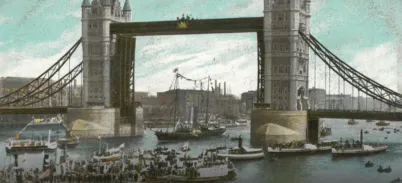
Top facts of Tower Bridge
Ready for a crash course about Tower Bridge? Here are your top facts and interesting things to know about London's defining landmark.

Design and architecture
It's newer than you think
Tower Bridge was opened to the public in 1894. When compared with its neighbour – the Tower of London (built in the 11th century) – it is rather young!
The Bridge may appear to be a stone castle-like structure, but its Neo-Gothic style design was chosen so that it complemented the White Tower, which was one of the stipulations of the original competition.
These style additions were used as an artistic flourish to cover the real structure of Tower Bridge, which is a solid steel frame partially visible through the windows of Tower Bridge.

It used to be brown
Its original colour was 'bright chocolate' brown, rumoured to be Queen Victoria’s favourite colour. You can still see the original paint colour when visiting inside Tower Bridge. This colour scheme survived until battleship grey was applied as camouflage pre-WW2.
In 1977, it was repainted the red, white and blue colours you can still see today, to celebrate Her Late Majesty The Queen’s Silver Jubilee.

It has Glass Floors
The Walkways that span the two towers were installed with Glass Floors in 2014, so that visitors can look down to the road and river below!
They are very strong and can hold the weight of more than two black taxi cabs, but the question is - when will you walk across them?

Did you know
The crests on top of our Towers are almost 63m above road level and are gilded with gold, and the length of central span between the Towers is almost 66m.
Engineering and construction
It was built after a public competition
Over 50 designs were submitted to a competition to win the contract for designing the Bridge.
After the competition was abandoned in 1879, architect Sir Horace Jones teamed up with civil engineer Sir John Wolfe Barry, to adapt his previously rejected design - pictured here with a large arch where the High-Level Walkways are now located.
The new design from Jones and Barry was proposed to the Court of Common Council on 28 October 1884 and then to Parliament in November 1884, where it was approved. Unfortunately, Jones died one year into the Bridge's construction and never got to see it finished.

It took immense skill to build
Building the Bridge took eight years to complete and ran to a cost of over £1 million.
Many different people were involved in the building of the Bridge, from the Divers who helped build into the bed of the River Thames to squads of Riveters who oversaw the elevation of the Towers by inserting over 13 million rivets into the steel.

It used steam power until 1976
When first built, Tower Bridge was the most sophisticated bascule bridge ever completed. The bascules were operated by hydraulics, using steam to power the enormous pumping engines.
Today, the bascules are still operated by hydraulic power, but are driven by oil and electricity rather than steam. You can see the original pumping engines, accumulators and boilers on display in the Engine Rooms.

It is not a drawbridge
Drawbridges require ropes or chains to pull up the road, but Tower Bridge’s roads are too heavy to be opened like this.
Instead, it is a bascule bridge, which means the roads (bascules) move like two giant seesaws and pivot to open and close the Bridge. The word bascule derives from the French for 'see-saw' or 'balance'.
Did you know
Around 31,000,000 bricks were used in the construction of Tower Bridge and the foundations into the riverbed are at a depth of almost 8m.
Legacy and location
It is often mistaken for London Bridge
London Bridge used to be the sole river crossing in London in Roman times. It has been rebuilt and changed many times since then. The modern concrete and steel structure we know today was opened to traffic in 1973.
Tower Bridge, on the other hand, has never fallen down. It stands today as it was built in 1894. It is known as London's defining landmark - representing London as an iconic structure that is recognised the world-over.
It's listed in two London boroughs
Tower Bridge's Towers are listed within two different London boroughs.
The south side of the Bridge belongs to Southwark, and was listed on 6 December 1949. Its North Tower, in Tower Hamlets, was listed decades later, on 27 September 1973.

Did you know
By law, a bundle of hay must be suspended from Tower Bridge when work is happening. This is to alert ships that there is less room to pass under its bascules than normal.
A working bridge
It opens for free
The Bridge is bound by an Act of Parliament to give river traffic priority over road traffic, which can sometimes be frustrating to car drivers stuck in rush hour traffic!
The Tower Bridge Act of 1885 also states that the Bridge is to be opened free of charge for river traffic.

Did you know
The highest-ever number of Bridge Lifts in one day was 64.
Book tickets now
There is so much more to discover inside Tower Bridge, from the unique views of the city to the history of London's defining landmark.